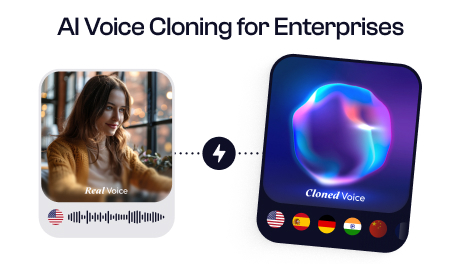


What is one of the most underrated ways for enterprises to cut costs, scale globally, and still sound authentic?
AI voice cloning.
It is no longer sci-fi. Enterprises today can replicate voices so accurately that they are almost indistinguishable from human recordings. The result? Faster localization, consistent branding, and an entirely new level of personalized customer experience.
If you are curious about how AI voice cloning can transform your enterprise, whether you are in media, training, or corporate communications, this guide is for you.
Key Takeaways
- AI voice cloning replicates real voices using machine learning to produce lifelike speech at scale.
- Enterprises benefit through speed, consistency, and localization, ideal for global brands and training-heavy industries.
- Real-world examples show how industries like entertainment, OTT, and e-learning are already saving time and money.
- Ethical and security considerations are essential; enterprises should use transparent, consent-based practices.
What Is AI Voice Cloning?
AI voice cloning uses advanced neural networks to analyze recordings of a person’s speech, then synthesize a near-perfect replica of that voice.
In practice, that means an enterprise can create high-quality audio from text without re-recording or hiring new voice talent each time.
Example:
A multinational bank can instantly create localized voiceovers for its mobile app in multiple languages, all in the same brand voice. No more juggling dozens of voice actors across markets.
For a hands-on demonstration, enterprises often test tools like Wavel AI’s AI Voice Cloner, which can generate lifelike, multilingual audio from just minutes of recorded samples.
Why Enterprises Should Pay Attention
Enterprises operate at scale: thousands of employees, multiple markets, diverse customer bases. Traditional audio production recording studios, voice actors, editing, simply can’t keep up. AI voice cloning solves for:
- Consistency: Your brand voice sounds the same across geographies, campaigns, and channels.
- Speed: Roll out multilingual content in days, not months.
- Cost Savings: Reduce studio time, talent fees, and post-production headaches.
- Personalization: Tailor experiences to individual customers or regions without losing quality.

Real-world illustration:
A global insurance company used AI voice cloning to standardize its IVR (interactive voice response) systems across 17 countries. Customers now hear the same friendly brand voice whether they call from Paris, Dubai, or Singapore. A Software Development Company in UAE offers advanced AI solutions that can enhance customer communication and service consistency.
Key Enterprise Use Cases for AI Voice Cloning
1. Media & Entertainment
Bring shows, films, and documentaries to global audiences faster. AI voice cloning allows studios to:
- Dub content into multiple languages using consistent character voices.
- Create trailer voiceovers without rebooking voice actors.
Example:
A documentary studio in Germany cloned its narrator’s voice to launch Spanish and French versions of its series on the same day as the original release, cutting its localization timeline from three months to three weeks.
2. OTT & Streaming Platforms
Launch content simultaneously worldwide with:
- Automated, high-quality voice localization.
- Consistent narrators across seasons and series.
Example:
Netflix has experimented with AI-driven dubbing for select titles, enabling near-simultaneous international launches. Smaller OTT platforms are now following suit to compete globally without massive budgets. Using a vimeo ott alternative helps these platforms deliver high-quality video content with streamlined distribution and localization.
3. E-Learning & Training
Train teams in their native language while keeping the same instructor voice:
- Onboard employees across regions with a familiar voice.
- Update modules without re-recording entire lessons.
Example:
Coursera and other global e-learning platforms are piloting AI voice cloning to release localized courses faster. An HR team can now update one module in English, and instantly distribute it in ten languages, all in the instructor’s original voice. Enterprises can also leverage qooper mentoring mentoring alongside AI voice cloning to deliver structured mentoring programs, onboarding, and skill development at scale across multiple regions.
4. Corporate & Internal Communications
Maintain clear, consistent messaging across your global workforce:
- CEO town halls can be automatically dubbed in multiple languages.
- Internal podcasts or updates can feature the same trusted voice.
Example:
A Fortune 500 retailer cloned its CEO’s voice for quarterly town-hall summaries, distributing multilingual audio updates to 200,000 employees within 24 hours.
5. Customer Support & IVR
Give your call center a recognizable, human-like brand voice:
- Clone a “brand voice” for automated systems.
- Offer personalized greetings and instructions in multiple languages.
Example:
A leading telecom used AI voice cloning to create a warm, conversational IVR in 12 languages—reducing call abandonment rates by 15%.
Real-Life Uses of AI Voice Clones
- Netflix uses AI-driven dubbing for select titles, enabling simultaneous launches.
- Global e-learning platforms like Coursera are testing AI voice cloning to offer localized courses faster.
- Banks and telecoms are creating branded IVR voices that are recognizable across all customer touchpoints.
- Healthcare providers are rolling out multilingual appointment reminders using cloned patient-service voices to improve engagement rates.
How to Implement AI Voice Cloning in Your Enterprise
- Identify High-Impact Areas
Audit where you are spending the most on voice talent, localization, or recording—training videos, IVRs, marketing spots. - Choose a Trusted Provider
Look for platforms like Wavel AI that offer:
- Consent-based voice cloning.
- Multilingual support.
- Enterprise-level security and compliance.
- Gather Quality Voice Data
The better the input, the better the cloned output. Work with your talent or leadership to record clean samples. - Test and Validate
Start with a pilot project, an internal training module or a regional ad to gauge quality and ROI. - Scale Securely
Roll out to more markets and departments once you’ve validated the process.
Ethical and Security Considerations
AI voice cloning is powerful but it must be used responsibly. Enterprises should:
- Obtain explicit consent from individuals whose voices are cloned.
- Implement safeguards against misuse (e.g., watermarking, internal-only access).
- Be transparent when cloned voices are used externally.
- Strengthen employee defenses against related security risks by using security awareness tools that build resilience against AI-driven phishing, deepfakes, and voice spoofing.
Doing so protects both the enterprise and the individuals involved. Reputable providers like Wavel AI include consent workflows and secure data handling to help enterprises stay compliant.
Tips for Getting the Most Out of AI Voice Cloning
- Combine voice cloning with multilingual AI dubbing to launch global campaigns instantly.
- Refresh content regularly; update scripts without costly re-recordings.
- Use analytics to track which voice versions perform best with different markets.
- Integrate with your existing CMS or LMS to automate updates.
- Pair cloned voices with AI captions and subtitles to maximize accessibility.
Conclusion
AI voice cloning is no longer a niche experiment. It’s a practical, scalable tool for enterprises to:
- Reach global audiences faster.
- Maintain brand consistency.
- Cut production costs dramatically.
- Deliver more personalized experiences.
By starting with a clear strategy and a trusted provider, enterprises can future-proof their audio strategy and stay ahead of competitors still relying on traditional voice production. The sooner you test and adopt, the sooner you’ll unlock the power of a scalable, consistent, and global brand voice.
FAQs
Q: Is AI voice cloning legal?
A: Yes, with proper consent and adherence to data protection laws.
Q: How much data do I need to clone a voice?
A: Usually a few minutes to a few hours of clean recordings, depending on the provider.
Q: Can cloned voices handle multiple languages?
A: Many enterprise solutions can synthesize cloned voices speaking different languages with near-native pronunciation.
Q: How secure is my voice data?
A: Enterprise-grade providers encrypt voice data and offer strict access controls.
Q: Will audiences know the voice is AI-generated?
A: High-quality clones are nearly indistinguishable. Transparency is recommended if authenticity is a core value.
